
MICCAI 2026 Oral presentation, Springer LNCS vol. 16881
CDPM-Align Multi-Scale Guidance-Aligned Diffusion Pretraining for Robust Few-Shot Anatomical Landmark Detection
1MaLGa-DIBRIS, University of Genoa, Italy 2Department of Computer Science, University of Oxford, UK
Abstract
Anatomical landmark detection is a fundamental task in medical image analysis supporting a wide range of diagnostic and interventional workflows. Although recent methods have achieved sub-millimetric localisation, accuracy alone is not sufficient for clinical deployment, requiring reliability and robustness in prediction. Despite its clinical relevance, the impact of representation learning in this context is still underexplored.
In this work, we introduce CDPM-Align, a multi-scale guidance-aligned conditional diffusion pre-training for anatomical landmark detection. Our experimental setup focuses on a few images and a few annotation regimes. Specifically, we employ three popular heterogeneous small-scale benchmark datasets for representation learning via conditional generative pre-training. Furthermore, we consider low-annotation scenarios for the downstream task of landmark detection, with 10 and 25 annotated images, reflecting realistic trade-offs between clinical effort and resource constraints for annotations.
Our results confirm that generative pre-training enables the model to learn a robust representation. This improves both accuracy and uncertainty on the downstream tasks, advancing towards safe and efficient clinical deployment.
Key contributions
Conditional generative pretraining strategy
We introduce a conditional generative pretraining strategy for small-scale heterogeneous X-ray datasets, augmented with a multi-scale guidance alignment loss that improves localisation accuracy, uncertainty concentration, and robustness in low-shot regimes.
Comprehensive validation
We validate the proposed method across three clinical dimensions (accuracy, predictive uncertainty, and robustness) on three public benchmarks under 10- and 25-shot protocols, showing consistent improvements over supervised, SSL, and state-of-the-art baselines.
Method
Conditional diffusion probabilistic model (CDPM)
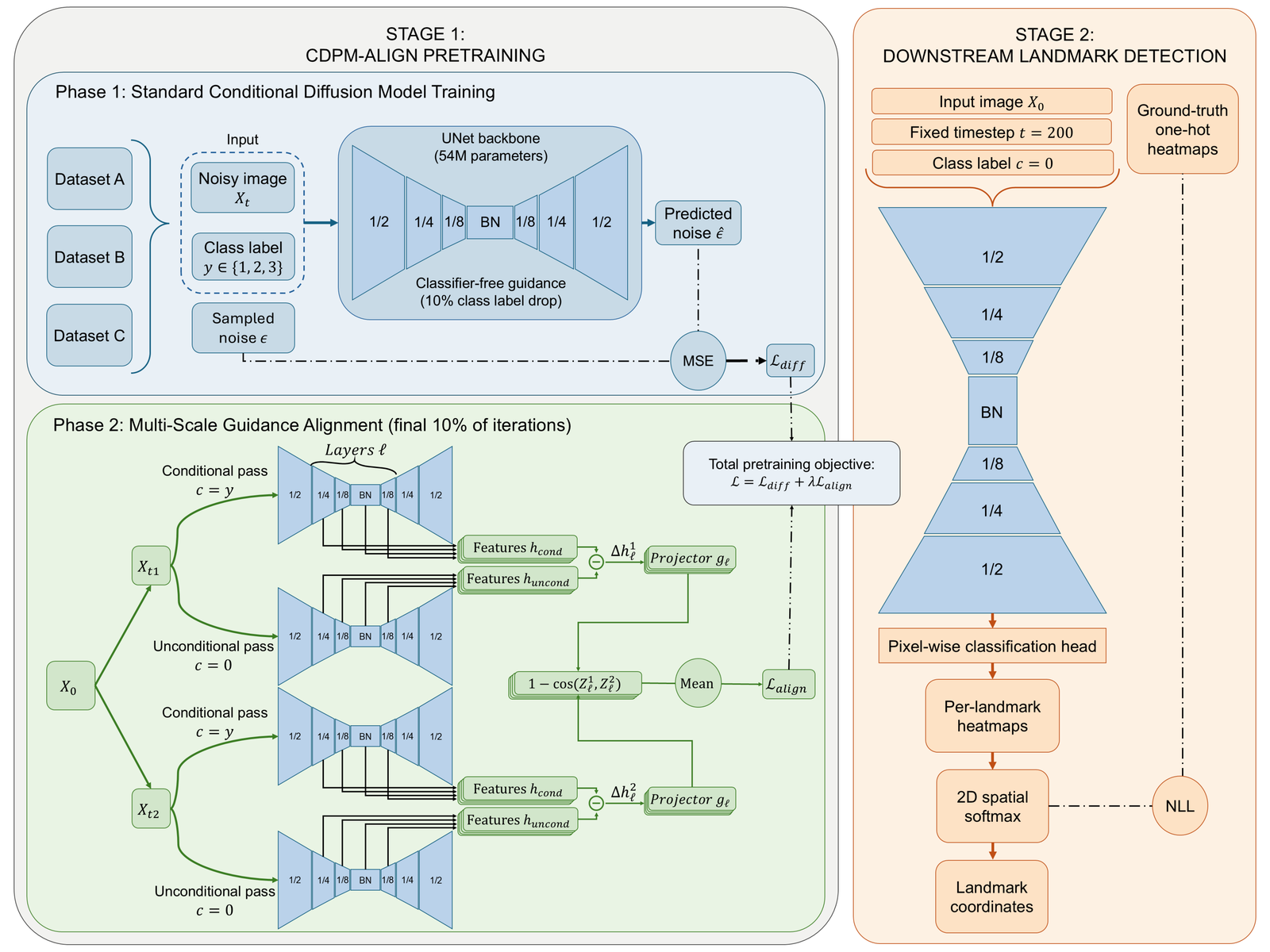
We build on denoising diffusion probabilistic models (DDPMs) with class-conditional generation via classifier-free guidance. The forward process produces noisy samples, and a noise-prediction network is trained with class labels (dataset indices). The backbone is a UNet with FiLM embeddings for timestep and class conditioning.
CDPM-Align: Multi-scale alignment on the guidance signal
We introduce a multi-scale alignment objective that enforces directional consistency of the guidance signal across independently sampled diffusion timesteps and UNet hierarchy levels. For each image, we sample two timesteps and perform forward passes with conditional and unconditional labels.
The guidance difference Δh = h_cond - h_uncond encodes dataset-specific anatomy. We extract features at four hierarchy levels: encoder 1/4, encoder 1/8, bottleneck, and decoder 1/8. The alignment loss averages the per-level cosine dissimilarity between the two views.
The alignment phase is applied only in the final 10% of training iterations, reducing computational overhead from 4× to 1.3×.
Downstream landmark detection
Following pretraining, the full pretrained UNet is fine-tuned end-to-end with a pixel-wise classification head. During fine-tuning and inference, the unconditional class label is used, decoupling the downstream task from pretraining labels and enabling future application to unseen datasets.
Experimental results
We evaluate on three public benchmarks: Shenzhen (279 chest radiographs, 6 landmarks), ISBI2015 (400 lateral cephalograms, 19 landmarks), and Digital Hand Atlas (DHA) (910 hand radiographs, 37 landmarks). The pooled unlabeled corpus comprises 988 images. Results are reported as mean±std over 5 independent runs.
Table 1. Landmark detection on Shenzhen
| Method | 10-shot | 25-shot | ||||||
|---|---|---|---|---|---|---|---|---|
| MRE↓ | ERE↓ | SDR@2↑ | P95↓ | MRE↓ | ERE↓ | SDR@2↑ | P95↓ | |
| Zhu et al. | 67.82 | 132.46 | 9.43 | 370.73 | 37.45 | 39.61 | 19.59 | 266.69 |
| Di Via et al. | 3.44 | 3.01 | 52.00 | 7.92 | 3.10 | 2.71 | 52.93 | 8.12 |
| ResNet-101 (ImageNet) | 5.18 | 4.07 | 43.87 | 10.23 | 3.09 | 3.16 | 45.67 | 6.91 |
| ResNet-101 (DINO) | 4.92 | 5.13 | 43.87 | 15.15 | 4.21 | 4.23 | 44.07 | 12.25 |
| CDPM (NIH, λ=0) | 2.89 | 2.49 | 53.40 | 6.41 | 2.65 | 2.50 | 53.53 | 6.77 |
| CDPM-align (Ours) | 3.01 | 2.96 | 53.07 | 7.17 | 2.58 | 2.58 | 56.00 | 6.51 |
Table 2. Landmark detection on ISBI2015
| Method | 10-shot | 25-shot | ||||||
|---|---|---|---|---|---|---|---|---|
| MRE↓ | ERE↓ | SDR@2↑ | P95↓ | MRE↓ | ERE↓ | SDR@2↑ | P95↓ | |
| Zhu et al. | 17.20 | 48.33 | 38.25 | 91.94 | 2.63 | 3.23 | 66.96 | 5.29 |
| Di Via et al. | 2.70 | 1.97 | 66.57 | 5.41 | 1.80 | 1.26 | 74.06 | 4.34 |
| ResNet-101 (ImageNet) | 2.83 | 2.38 | 64.20 | 5.42 | 2.86 | 2.37 | 68.83 | 4.87 |
| ResNet-101 (DINO) | 4.71 | 3.96 | 54.29 | 18.88 | 2.36 | 1.94 | 66.98 | 5.09 |
| CDPM (NIH, λ=0) | 2.32 | 1.78 | 68.12 | 5.20 | 1.70 | 1.19 | 75.49 | 4.04 |
| CDPM-align (Ours) | 2.11 | 1.38 | 67.48 | 4.75 | 1.54 | 0.95 | 77.52 | 3.90 |
+22% improvement on ISBI2015 10-shot (2.11 vs 2.70 mm). At 25-shot: 1.54 mm MRE with 77.52% SDR, approaching the 2mm clinical threshold.
Table 3. Landmark detection on DHA
| Method | 10-shot | 25-shot | ||||||
|---|---|---|---|---|---|---|---|---|
| MRE↓ | ERE↓ | SDR@2↑ | P95↓ | MRE↓ | ERE↓ | SDR@2↑ | P95↓ | |
| Zhu et al. | 33.85 | 90.66 | 44.48 | 161.83 | 2.87 | 4.95 | 83.13 | 4.04 |
| Di Via et al. | 4.34 | 3.01 | 79.94 | 19.11 | 2.22 | 1.48 | 88.28 | 3.67 |
| ResNet-101 (ImageNet) | 6.07 | 5.76 | 78.44 | 26.39 | 3.95 | 4.39 | 84.07 | 7.65 |
| ResNet-101 (DINO) | 23.63 | 22.38 | 34.95 | 99.49 | 10.16 | 10.24 | 63.83 | 46.98 |
| CDPM (NIH, λ=0) | 4.08 | 3.24 | 80.50 | 16.41 | 1.62 | 1.19 | 89.80 | 3.18 |
| CDPM-align (Ours) | 2.51 | 2.16 | 86.47 | 4.46 | 1.53 | 0.97 | 91.13 | 2.77 |
+42% improvement on DHA 10-shot (2.51 vs 4.34 mm). SSL methods (red) exhibit severe performance degradation on heterogeneous data.
Uncertainty visualization
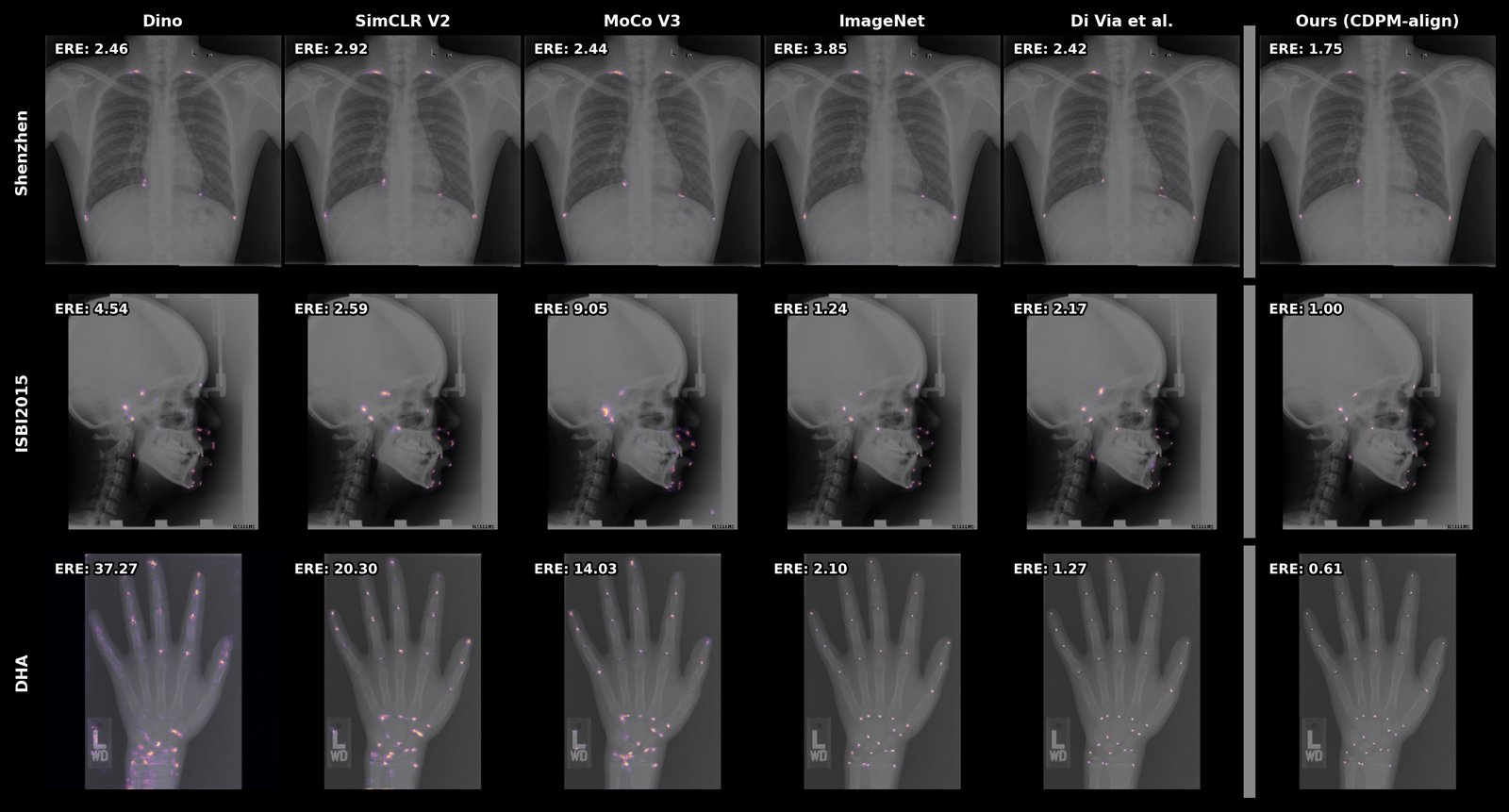
Key findings
State-of-the-art few-shot performance
CDPM-align achieves best MRE in 5/6 dataset-budget settings
Sub-millimetre ERE
At 25-shot, achieves ERE below 1mm on ISBI2015 (0.95mm, +25% improvement) and DHA (0.97mm, +34% improvement)
Robustness on heterogeneous data
SSL methods exhibit severe performance degradation on DHA at 10-shot (MRE 20-25mm vs 2.51mm for CDPM-align)
Data-efficient
Pretrained on only 988 images, it matches or surpasses models trained on 112k NIH radiographs
Key improvements
+22% on ISBI2015 10-shot, +42% on DHA 10-shot
Ablation studies
Table 4. Ablation of alignment weight λ on Shenzhen
| λ | 10-shot | 25-shot | ||||||
|---|---|---|---|---|---|---|---|---|
| MRE↓ | ERE↓ | SDR@2↑ | P95↓ | MRE↓ | ERE↓ | SDR@2↑ | P95↓ | |
| 0 | 3.95 | 3.35 | 51.60 | 9.30 | 2.75 | 2.69 | 53.20 | 7.20 |
| 1 | 3.82 | 3.28 | 51.53 | 9.44 | 2.61 | 2.59 | 53.47 | 7.00 |
| 3 | 3.25 | 2.88 | 52.20 | 7.03 | 2.89 | 2.57 | 53.47 | 7.26 |
| 5 | 3.01 | 2.96 | 53.07 | 7.17 | 2.58 | 2.58 | 56.00 | 6.51 |
| 10 | 3.42 | 2.78 | 52.67 | 7.23 | 2.74 | 2.37 | 53.93 | 7.23 |
λ=5 provides the best balance between accuracy, uncertainty, and robustness. ERE is lowest at λ=10, but this doesn't translate to optimal spatial accuracy.
MICCAI 2026 oral and poster
Oral presentation (10 min)
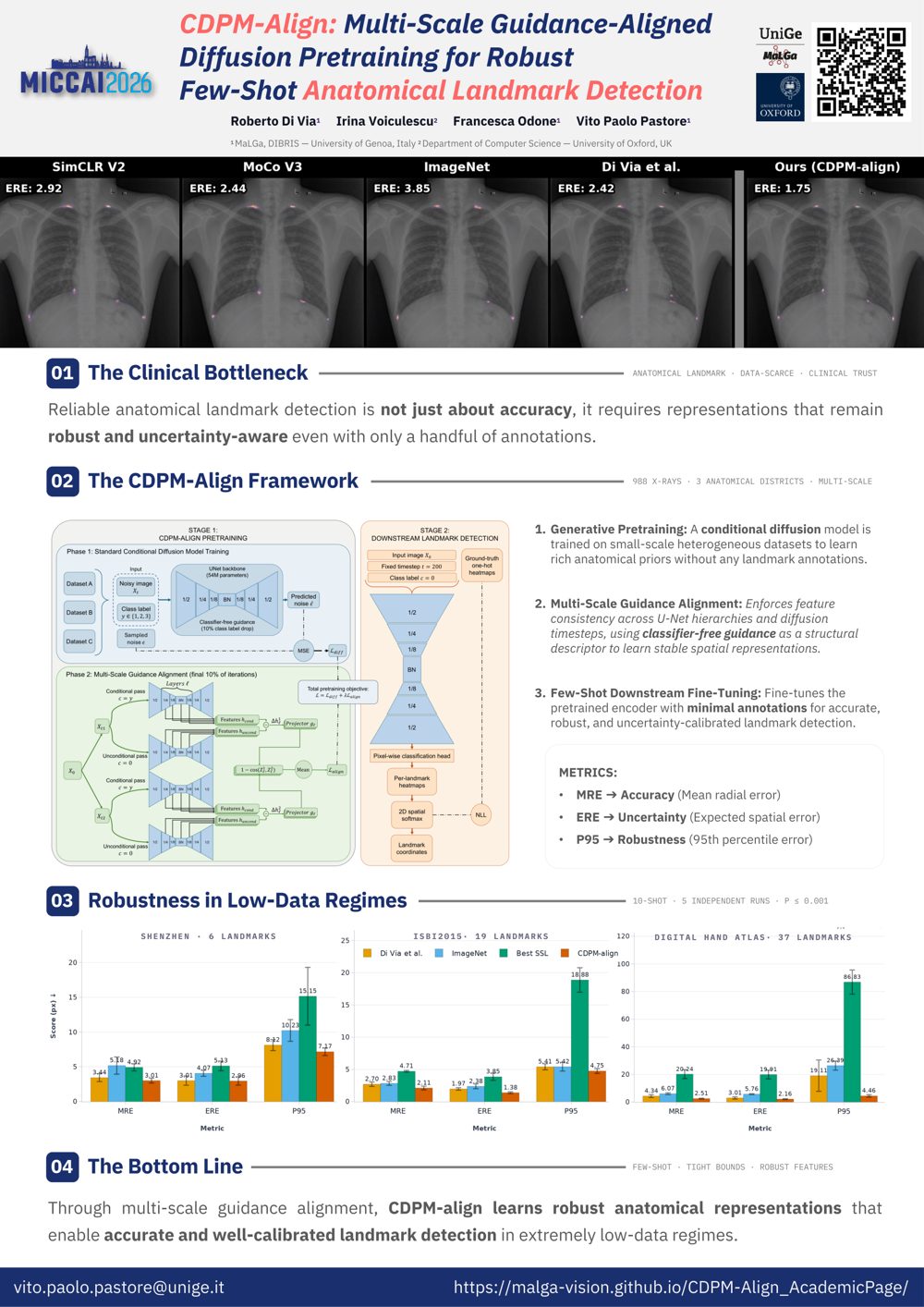
Frequently asked questions
What is CDPM-Align?
CDPM-Align is a pretraining method for anatomical landmark detection in X-ray images, published at MICCAI 2026. It trains a class-conditional diffusion model (CDPM) with classifier-free guidance on small heterogeneous X-ray datasets and adds a multi-scale alignment loss that enforces directional consistency of the guidance signal across independently sampled diffusion timesteps and UNet hierarchy levels. The pretrained UNet is then fine-tuned end-to-end for landmark detection with a pixel-wise classification head.
What data is CDPM-Align pretrained and evaluated on?
It is pretrained on a pooled unlabeled corpus of only 988 X-ray images from three public benchmarks: Shenzhen (279 chest radiographs, 6 landmarks), ISBI2015 (400 lateral cephalograms, 19 landmarks) and the Digital Hand Atlas DHA (910 hand radiographs, 37 landmarks). Landmark detection is evaluated with 10 and 25 annotated images, reporting mean and standard deviation over 5 independent runs.
How well does CDPM-Align perform?
CDPM-Align achieves the best mean radial error (MRE) in 5 of 6 dataset-budget settings: +22% on ISBI2015 at 10 shots (2.11 vs. 2.70 mm) and +42% on DHA at 10 shots (2.51 vs. 4.34 mm). At 25 shots its expected radial error (ERE) is below 1 mm on ISBI2015 (0.95 mm) and DHA (0.97 mm). Pretrained on 988 images, it matches or surpasses a model pretrained on 112k NIH chest radiographs.
Why not use self-supervised pretraining instead?
On heterogeneous multi-district data, discriminative self-supervised objectives (DINO, MoCov3, SimCLRv2) degrade severely: on DHA at 10 shots they reach an MRE of 20-25 mm, against 2.51 mm for CDPM-Align. The denoising objective does not rely on global image discrimination, so generative pretraining is not affected.
Is the code available?
Yes. The official PyTorch code, configurations and instructions for pretraining and few-shot landmark detection are at github.com/Malga-Vision/CDPM-Align. The follow-up work PACER (WACV 2027) finetunes a CDPM-Align detector on an unlabeled pool with curriculum self-training.
Citation
@inproceedings{divia2026cdpm,
  title={{CDPM-Align}: Multi-Scale Guidance-Aligned Diffusion Pretraining for Robust Few-Shot Anatomical Landmark Detection},
  author={Di Via, Roberto and Voiculescu, Irina and Odone, Francesca and Pastore, Vito Paolo},
  booktitle={Medical Image Computing and Computer Assisted Intervention -- MICCAI 2026},
  series={Lecture Notes in Computer Science},
  volume={16881},
  pages={89--99},
  publisher={Springer Nature Switzerland},
  year={2026},
  doi={10.1007/978-3-032-38072-2_9}
}